



Key Takeaways
- No single metric tells the whole story — but together, they give you a much clearer picture of your health. BMI is a useful starting point, but it doesn’t distinguish between muscle and fat or account for where fat is stored. Pairing it with waist-to-height ratio, waist-to-hip ratio, and body fat percentage builds a far more accurate and actionable picture of your risk.
- Where you carry fat matters as much as how much you carry. Visceral fat — stored around the abdomen — is strongly linked to insulin resistance, inflammation, high blood pressure, and increased risk of heart disease and type 2 diabetes. Waist-to-height and waist-to-hip ratios are simple measures that can flag central obesity even when BMI appears normal.
- Tracking these metrics over time is more valuable than any single reading. Most serious conditions develop gradually, and early data gives you the best window for intervention. e-Surgery’s Health Calculators — available on your dashboard — are designed to help you monitor trends, understand your body, and have more informed conversations with your GP.
As we age, the things we love most depend on one thing above everything else: staying well enough to do them. Most of us have stood on a set of scales, watched the number, and wondered what it actually means. With so many fad trends and conflicting advice online — macros, step counts, biohacking — it can be genuinely difficult to tell what actually matters.
Most serious health conditions — type 2 diabetes, cardiovascular disease, hypertension — don’t arrive suddenly. They develop quietly over years, driven in large part by factors that are measurable long in advance. The challenge is that by the time people notice something is wrong, the window for easy intervention has often closed.
Simple metrics change that equation. They give you a way to check in with your body regularly, notice trends over time, and take action early — whether that means adjusting your diet, increasing your activity, or having a more informed conversation with a healthcare professional.
Here at e-Surgery, we’ve developed a suite of health metric calculators to cut through the noise. They’re not diagnostic tools, and they won’t replace a conversation with your GP — but they can help you understand your body in ways that a single number never could.
To access these calculators, log in to your e-Surgery account and go to your dashboard, then scroll down, you’ll see a new section called “Health Calculators”.
Body Mass Index, A Start

Body Mass Index (BMI) is the most widely used health metric in the world, and for good reason: it’s quick, simple, and requires nothing more than your height and weight. The formula divides your weight in kilograms by the square of your height in metres. The result places you in one of four broad categories: underweight, healthy weight, overweight, or obese.
For most people, BMI does a reasonable job of flagging potential weight-related health risks. But it has well-known limitations that are worth understanding.
BMI doesn’t distinguish between muscle and fat. A professional athlete with significant muscle mass may register as “overweight” despite being in excellent health. Conversely, someone with a “healthy” BMI can still carry dangerous amounts of body fat in all the wrong places. BMI also doesn’t account for age, sex, or ethnicity — all of which affect how body composition relates to health risk.
Waist-to-Height Ratio: Where Fat Lives Matters
If BMI is about how much, waist-to-height ratio is about where. And where you carry fat turns out to be critically important.
Fat stored around the abdomen — sometimes called visceral fat — wraps around your internal organs and is metabolically active in ways that subcutaneous fat (the kind just under the skin) is not. High levels of visceral fat are strongly associated with insulin resistance, inflammation, elevated blood pressure, and an increased risk of heart disease and type 2 diabetes.
The waist-to-height ratio is calculated by dividing your waist circumference by your height, both measured in the same units. A ratio below 0.5 is generally considered healthy — in other words, your waist should be less than half your height. Studies have suggested it may actually be a better predictor of cardiovascular risk than BMI alone, particularly for people whose BMI falls in the “normal” range but who carry weight centrally.
Waist-to-Hip Ratio: The Shape of Risk
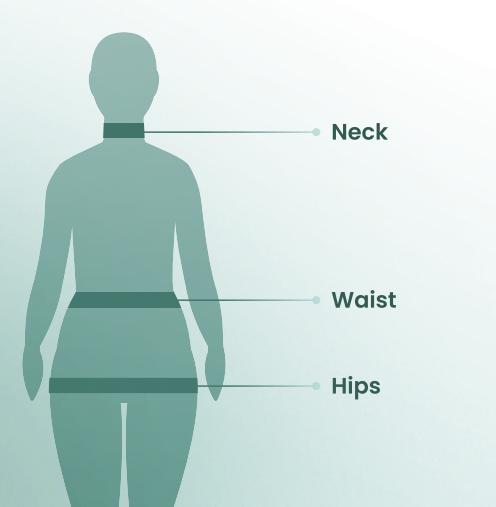
Where waist-to-height ratio looks at central fat relative to overall body size, waist-to-hip ratio looks at fat distribution between two specific regions.
People who carry weight around their middle (an “apple” shape) face different health risks than those who carry it around their hips and thighs (a “pear” shape). The waist-to-hip ratio captures this distinction by dividing waist circumference by hip circumference.
The World Health Organization considers a waist-to-hip ratio above 0.90 for men, or 0.85 for women, to indicate abdominal obesity and associated elevated health risk. It’s a simple measure, but one that adds another layer of nuance to the picture that BMI alone can’t provide.
Body Fat Percentage: The Navy Method
Knowing your body fat percentage gets closer to the heart of what we’re actually trying to understand. Rather than estimating risk indirectly through weight and height, it estimates the proportion of your body that is fat — and that proportion matters enormously for health outcomes.
We use the US Navy method, which estimates body fat from a few simple circumference measurements: neck, waist, and hips (for women), alongside height. It is more accessible and provides a useful estimate for most people.
Healthy body fat ranges differ by sex and age. Tracking changes in body fat percentage over time — through our body fat progress chart — can be more meaningful than tracking weight alone, since it helps distinguish fat loss from muscle gain, and vice versa.
Ideal Weight: A Range, Not a Number

The ideal weight calculator works backwards from a healthy BMI range — typically 18.5 to 24.9 — to give a weight range that would fall within those bounds at your height.
It’s important to treat this as a guide rather than a target. The same caveats that apply to BMI apply here: muscle mass, bone density, age, and body composition all affect what a healthy weight looks like for any individual. The range gives you a useful reference point, but your ideal weight is ultimately something to explore with a healthcare professional, not a figure to chase at any cost.
TDEE: Understanding Your Energy Balance
Total Daily Energy Expenditure (TDEE) is the estimated number of calories your body burns in a day, accounting for your age, sex, height, weight, and activity level. It’s the baseline from which almost all nutrition and weight management conversations begin.
Understanding your TDEE doesn’t mean obsessively counting every calorie. But it does help demystify why weight changes, why what works for one person doesn’t work for another, and what “eating to maintenance” actually means for your body specifically. It shifts the conversation from vague notions of eating less and moving more to something more grounded and personal.
Putting It Together
None of these metrics tells the whole story on its own. BMI without waist measurements can miss central obesity. Body fat percentage without TDEE misses the energy picture. But together — across our BMI calculator, waist-to-height ratio, waist-to-hip ratio, and body fat progress chart — they begin to build a more complete, more useful portrait of where you are and what might be worth paying attention to.
Think of them not as judgements, but as information. The earlier you have it, the more you can do with it.


