
The short answer: An online ADHD checker for adults, such as the World Health Organization Adult ADHD Self-Report Scale (ASRS), is a screening questionnaire. It suggests whether your symptoms are worth discussing with a doctor. It can’t diagnose ADHD: NICE guidance says a diagnosis must be made by a specialist after a full clinical and psychosocial assessment. If your results suggest ADHD traits, the next step is to speak to your GP.
Perhaps it started when your child was diagnosed, or when a video online described your daily life almost exactly. You may have recognised patterns you’ve lived with for years: losing things, missing deadlines, struggling to start tasks, or feeling restless when others seem settled. Many adults in this position try an ADHD checker for adults, then another, and end up with mixed results and more questions than answers.
This guide explains what online screening tools are designed to do, what your score may mean, and how to take a clear, practical next step.
What is an ADHD checker for adults?
ADHD stands for attention deficit hyperactivity disorder. It is a condition that affects attention, activity levels and impulse control (acting quickly without thinking things through). An ADHD checker is a short questionnaire that asks how often you experience behaviours commonly associated with ADHD.
The most widely recognised adult screener is the WHO Adult ADHD Self-Report Scale, version 1.1 (ASRS v1.1). Its short screening section asks six questions about how often, over the past six months, you’ve had difficulties such as:
- finishing the final details of a project
- getting things in order when a task needs organisation
- remembering appointments or obligations
- getting started on tasks that need a lot of thought
- fidgeting or squirming when you have to sit for a long time
- feeling overly active or compelled to do things, “as if driven by a motor”
Many free online quizzes are not based on a validated tool like the ASRS. “Validated” means a questionnaire has been tested in research to check that it measures what it claims to measure.

Can an online ADHD test for adults tell me if I have ADHD?
No. An ADHD test for adults found online is a screening tool, not a diagnostic test. Screening identifies people who may benefit from further assessment; diagnosis confirms whether a condition is present.
NICE guideline NG87 states that ADHD should not be diagnosed on the basis of rating scales or observation alone. Rating scales can support an assessment, but they don’t replace a full clinical assessment by a specialist, such as a psychiatrist or another appropriately trained healthcare professional.
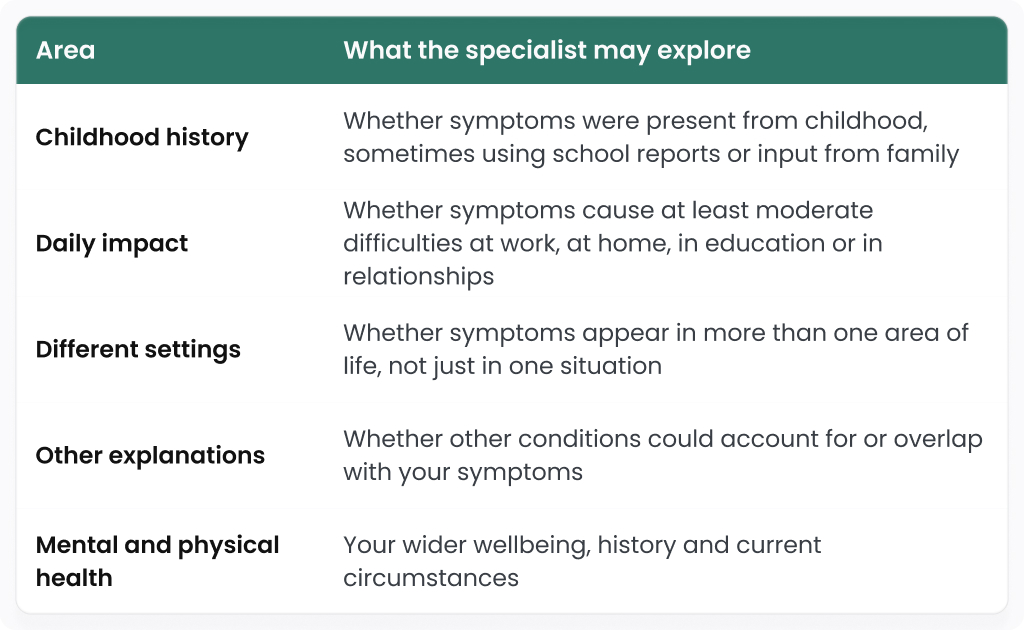
What a full assessment looks at
A specialist assessment usually considers much more than a questionnaire can capture, including:
Why do free ADHD tests give different results?
If you’ve tried several ADHD test free tools and got different answers, that’s common and doesn’t mean you’ve done anything wrong. Results can vary because:
- The quizzes differ. Some are based on validated scales; others are written without clinical testing.
- Questions are open to interpretation. “Often” may mean different things to different people.
- Your day affects your answers. Stress, tiredness or low mood can change how you rate yourself.
- There’s no context. A quiz can’t weigh up your childhood history or rule out other causes.
A quiz result is a starting point for a conversation, not a conclusion.

What does my screening score actually mean?
If a validated screener such as the ASRS suggests your symptoms are consistent with ADHD, it means your answers resemble those of adults who were later found to have ADHD in research. It’s a signal that a conversation with a clinician may be worthwhile.
A high score doesn’t confirm ADHD. A low score doesn’t rule it out either, particularly if you’ve learned ways to mask or compensate for difficulties over many years. If your symptoms are affecting your life, it’s reasonable to speak to your GP whatever your score.
Do I have ADHD, or could it be something else?
Asking “do I have ADHD?” is understandable, especially when you recognise yourself in descriptions online. The NHS lists symptoms of ADHD in adults that can include poor organisation, difficulty focusing or prioritising, forgetfulness, losing things, restlessness, impulsiveness, mood swings and difficulty coping with stress.
However, many of these experiences are also associated with other things, such as anxiety, depression, sleep problems, stress or some physical health conditions. ADHD can also occur alongside other conditions. This overlap is one reason a full clinical assessment matters: it helps make sure you get support that fits your situation.
What should I do after an ADHD checker?
1. Speak to your GP
Your GP can’t usually diagnose ADHD themselves, but they can discuss your symptoms, consider other possible causes and refer you to a specialist assessment service if appropriate. It can help to bring:
- your screening results, labelled as a screening questionnaire
- notes on how your symptoms affect work, home and relationships
- examples from childhood, such as old school reports, if you have them
- input from someone who knows you well, if you’re comfortable sharing it
2. Consider a regulated private assessment
Some people choose a private assessment. If you do, check that the provider is registered with the relevant regulator (in England, the Care Quality Commission) and that assessments are carried out by appropriately qualified specialists. It’s also worth asking your GP in advance whether they would consider a shared care agreement, an arrangement where your GP takes over prescribing after a specialist starts treatment, as not all GPs will agree to this.

What support and treatment options are there?
If you’re diagnosed with ADHD, NICE NG87 recommends that treatment and support are tailored to you. Options your specialist may discuss include:
- Information and support to help you understand ADHD and how it affects you
- Practical adjustments at work, in education or at home, such as structured routines or reminders
- Psychological support, which may include approaches such as cognitive behavioural therapy (CBT), a talking therapy focused on thoughts and behaviours
- Medication, which may be considered after a specialist assessment, alongside regular monitoring
Treatment decisions are always made after an individual clinical assessment, taking into account your health, preferences and circumstances. Not everyone with ADHD wants or needs medication.
Staying safe while looking for answers
Important cautions
- Don’t self-diagnose or self-treat. ADHD medicines are prescription-only, and several are controlled drugs. Buying them without a prescription, or from unregulated websites, can be unsafe and illegal.
- Be cautious with paid online “diagnoses” that rely only on a quiz or a short questionnaire.
- Look after your wellbeing. Repeated quizzes and online content can sometimes increase worry. It’s fine to step back and talk to a professional instead.
When to seek help urgently
Contact your GP or NHS 111 if you’re struggling to cope day to day, or if low mood, anxiety or stress are getting worse. In England, you can also call NHS 111 and select the mental health option.
Call 999 or go to A&E if you have thoughts of harming yourself or ending your life and feel you may act on them, or if you’re worried someone else is in immediate danger. You can also call Samaritans free, any time, on 116 123.
Sources and further reading
- National Institute for Health and Care Excellence (NICE). Attention deficit hyperactivity disorder: diagnosis and management (NG87). Section 1.3, Diagnosis.
- NICE Clinical Knowledge Summaries. Attention deficit hyperactivity disorder: Diagnosis (adults).
- NHS. Symptoms – Attention deficit hyperactivity disorder (ADHD).
- NHS. Diagnosis – Attention deficit hyperactivity disorder (ADHD).
- World Health Organization. Adult ADHD Self-Report Scale (ASRS-v1.1) Symptom Checklist.
- Royal College of Psychiatrists. ADHD in adults (patient information).
Medically reviewed by Dr Thomas Verghese, MBBCh, MRCPsych, PGCertMedEd