

Rated 4.7


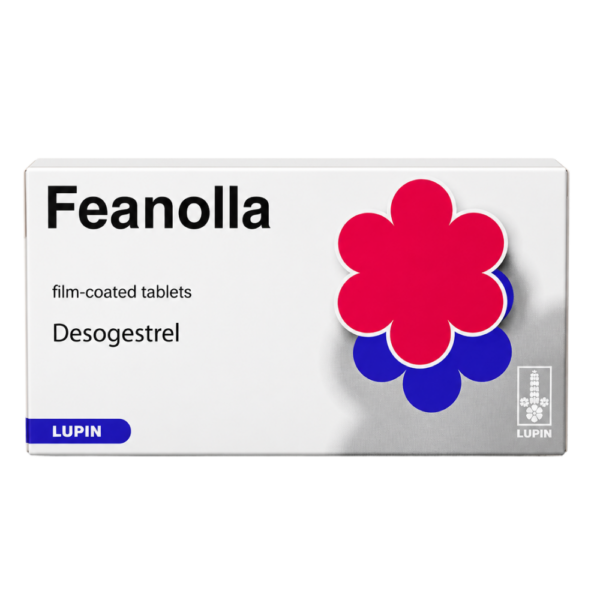
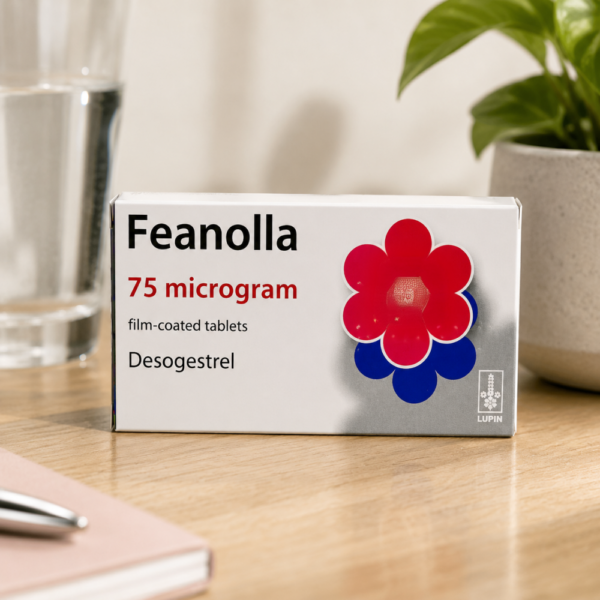
Feanolla Tablets
Prescription Only Medication (POM)

Price Checker
Please select the product variation first.
Related Products




About the product
Feanolla Tablets are a progestogen-only contraceptive pill, also known as the “mini pill,” used to prevent pregnancy.
They contain desogestrel, which works mainly by stopping ovulation, thickening cervical mucus to make it harder for sperm to reach an egg, and altering the womb lining to reduce the chance of implantation.
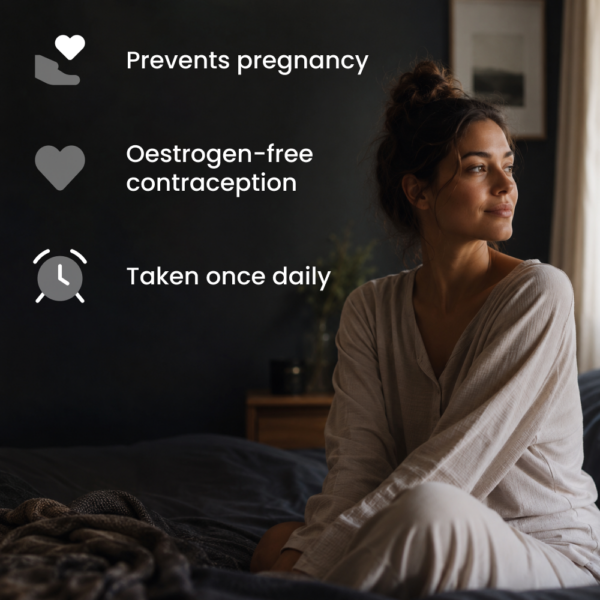
Feanolla does not contain oestrogen, making it suitable for women who cannot take oestrogen-based contraception. The tablets are taken once daily at the same time each day, with no break between packs. When used correctly, Feanolla is over 99% effective at preventing pregnancy.
Source: British National Formulary (BNF) – Norethisterone / Desogestrel
Overview
FAQ
Directions
Side Effects
How it works
Delivery
Ingredients
Warnings
Overview
Feanolla is a hormonal contraceptive mini-pill that contains only progestogen that can be used to prevent pregnancy. This form of contraception will not protect you against STIs, only a condom has that capability.
Feanolla tricks your body into believing it is pregnant by keeping your progestogen levels high, which prevents your ovaries from releasing an egg.
We advise that all of our patients seek the advice of either their doctor or prescriber before they begin their Feanolla treatment. This is to ensure that you receive the correct treatment for you.
Frequently Asked Questions
Have a question? We're here to help
Are there any Interactions between Feanolla with alcohol and food?
There is no evidence to suggest that any particular food or alcohol will affect the effectiveness of Feanolla.
Are there any interactions between Feanolla and other drugs?
There is a potential for Feanolla to interact with other drugs, so we advise that before mixing medications our patients consult with either their doctor or prescriber.
To get more information on the potential drug interactions of Feanolla, please visit the Feanolla Patient information leaflet.
What happens if you take Feanolla too late?
The effectiveness of Feanolla is decreased if not taken at the appropriate time and as instructed by either your doctor or prescriber. If you have forgotten to take a tablet or are late in taking one then we advise you to consult with your GP or prescriber before continuing treatment.
When should you stop using Feanolla?
You should stop taking your Feanolla and see a doctor immediately if you get symptoms of a blood clot. You should also stop taking it when your body requires a break from the medication but you should consult with either your doctor or prescriber to decide when this will be.
Is it better to take Feanolla in the morning?
You should try to take your Feanolla at around the same time every day to ensure that it is as effective as it can be in preventing pregnancy. If you miss a day or the 3-hour window time frame or are concerned that you have not correctly taken your Feanolla then we advise that you consult with your doctor or prescriber.
Is it better to take Feanolla in the morning?
It is advised that you take your Feanolla at the same time every day so that it is effective in preventing pregnancy. It does not matter what time to start taking it initially.
Do you have to take Feanolla at the same time every day?
You should try to take your Feanolla at the same time every day to ensure that it is as effective as it can be in preventing pregnancy. If you miss a day or are concerned that you have not correctly taken your Feanolla then we advise that you consult with your doctor or prescriber.
Are there any Feanolla alternatives?
e-Surgery offers a range of contraceptives that can be used to prevent pregnancy. We advise that you consult with your doctor or prescriber before you buy Feanolla or any other contraception to ensure you receive the correct treatment for you.
Can you take Feanolla with painkillers?
There is no evidence to suggest that consuming painkillers such as paracetamol is unsafe when you are also taking Feanolla. However, we advise that you consult with either your doctor or prescriber before you take other medication, including painkillers alongside your current Feanolla treatment.
What is Feanolla used for?
Feanolla is used to prevent pregnancy. It’s a type of contraceptive tablet called a progestogen-only pill, because it contains one hormone, a progestogen called desogestrel, rather than the combination of hormones used in the combined pill.
Most progestogen-only pills work mainly by making it harder for sperm to reach the womb, without reliably stopping an egg from being released. Feanolla’s dose is high enough to also stop the ovaries from releasing an egg in most cases, which gives it high contraceptive effectiveness.
Feanolla can be used by women who don’t tolerate oestrogen-based contraception, and by women who are breastfeeding. It does not protect against sexually transmitted infections.
What is Feanolla?
Feanolla is a contraceptive tablet that contains a hormone called desogestrel. Because it contains only this one hormone, rather than the combination used in the combined pill, it’s known as a progestogen-only pill.
In most cases, its dose is high enough to also stop the ovaries from releasing an egg each month, which gives it higher effectiveness than most other progestogen-only pills when taken correctly. Unlike the combined pill, Feanolla doesn’t contain oestrogen, so it can be used by women who don’t tolerate oestrogen-based contraception, and by women who are breastfeeding.
Feanolla comes as a pack of 28 tablets, taken one a day at around the same time, with no tablet-free break between packs.
It does not protect against sexually transmitted infections.
How to take Feanolla?
Every pack of Feanolla contains 28 tablets, one for each day of the cycle, with no tablet-free break between packs. Take one tablet each day at around the same time, swallowed whole with water, and start a new pack the day after finishing the last one.
How you start your first pack depends on your situation:
- If you haven’t used hormonal contraception in the past month, take your first tablet on day 1 of your period. If you start on days 2 to 5 instead, use an additional barrier method, such as condoms, for the first 7 days.
- If you’re switching from the combined pill, a vaginal ring or a patch, you can start Feanolla the day after your last active tablet, or the day you remove your ring or patch, without needing extra precautions. If you start later, after your usual break, use an additional barrier method for the first 7 days.
- If you’re switching from another progestogen-only pill, an injection, an implant, or a hormonal IUD, you can generally start Feanolla without needing extra contraceptive precautions, timed around your previous method.
- If you’ve recently had a baby, or had a miscarriage or termination, speak to your doctor about the right time to start, as the timing is different to the situations above.
If you’re more than 12 hours late taking a tablet, its effectiveness may be reduced. Take the missed tablet as soon as you remember, continue as normal, and use an additional barrier method for the next 7 days. If you missed tablets in your first week of taking Feanolla and had sex in the week before, speak to your doctor, as there’s a chance you could be pregnant.
If you’re sick within 3 to 4 hours of taking a tablet, or have severe diarrhoea, follow the same advice as for a missed tablet, as the dose may not have been fully absorbed.
How long does Feanolla take to work?
If you start Feanolla on the first day of your period, it protects against pregnancy straight away and you don’t need to use additional contraception.
If you start on days 2 to 5 of your cycle instead, you’ll need to use an additional barrier method, such as condoms, for the first 7 days of taking Feanolla, since protection isn’t immediate in this case.
If you’re switching from the combined pill, a vaginal ring or a patch, starting with no break, straight after your last active tablet or on the day you remove your ring or patch, gives you immediate protection. If you start later, after your usual break, you’ll need a barrier method for the first 7 days.
If you’re switching directly from another progestogen-only pill, an injection, an implant, or a hormonal IUD, following the recommended switch-over timing means you’re protected without needing extra precautions.
Your doctor or pharmacist can confirm exactly when your protection starts based on your own starting point and cycle.
How to start taking Feanolla?
If you haven’t used hormonal contraception in the past month, take your first tablet on day 1 of your period, no extra precautions needed. Starting on days 2 to 5 instead means using a barrier method, such as condoms, for the first 7 days.
If you’re switching from the combined pill, a vaginal ring or a patch, start with no break for immediate protection. Starting later, after your usual break, needs a barrier method for 7 days.
Switching from another progestogen-only pill, an injection, an implant, or a hormonal IUD usually means no break and no extra precautions.
After having a baby, you can usually start between 21 and 28 days after birth. If you’ve already had sex since giving birth, speak to your doctor first, as pregnancy needs to be ruled out.
Your doctor or pharmacist can confirm the exact timing for your situation.
When to start Feanolla?
If you haven’t used hormonal contraception in the past month, take your first tablet on day 1 of your period, no extra precautions needed. Starting on days 2 to 5 instead means using a barrier method for the first 7 days.
If you’re switching from another contraceptive, such as the combined pill, another progestogen-only pill, an injection, implant or hormonal IUD, you can usually start Feanolla straight away without a break and without extra precautions.
After having a baby, you can usually start between 21 and 28 days after birth. If you’ve already had sex since giving birth, speak to your doctor first.
Your doctor or pharmacist can confirm the exact timing for your situation.
Directions
You should take Feanolla on the first day of your period. From this day, you should take a pill every day orally and with water if necessary. You can take your first Feanolla at any point during the day as long as the following tablets are taken once daily and within a 3-hour time frame after the first.
We advise that all of our patients seek the advice of either their doctor or prescriber before they begin their Feanolla treatment. This is to ensure that you receive the correct treatment for you.
Side Effects
Side effects of Feanolla include:
- Stomach upset
- Headaches
- Migraines
- Swollen or sore breasts
- Changes in sex drive
- Mood changes
- Cysts on your ovaries
- Irregular periods
- Acne
To get more information on the potential side effects of Feanolla, please visit the Feanolla Patient information leaflet.
How it works
Feanolla tricks your body into believing it is pregnant by keeping your progestogen levels high, which prevents your ovaries from releasing an egg.
Delivery
e-Surgery uses Royal Mail delivery with choices starting from Royal Mail 48 tracked delivery, Royal Mail tracked 24, and Royal Mail 1pm special delivery (discover more about e-Surgery delivery).
When you buy Feanolla online they will arrive in discreet, recyclable packaging at a delivery address of your choice. Find out how to recycle packaging from e-Surgery.
Ingredients
The active ingredient inside Feanolla is desogestrel.
Warnings
You should not take Feanolla if you:
- are allergic to any of the ingredients
- are or think you may be pregnant
- have or have ever had acute or severe chronic liver disease
- have a metabolism disorder
- have unexplained vaginal bleeding
- have never had a period or your periods have suddenly stopped
- have inflamed veins
- have or have had DVT
- have heart disease or have had a stroke
- have experienced jaundice (yellowing of the skin and eyes) or pruritus (itching all over the body) during pregnancy
See what people are saying about Feanolla Tablets online
Total reviews
And still counting
Average rating
Average rating this year

Same day dispatch:
0 minutesSame day dispatch:
0 minutesFeanolla Tablets
Same day dispatch:
0 minutesRelated Products



Superintendent Pharmacist: Justin Dicks 2038305
© Total Access Health LTD. All rights reserved.
Pharmacy Address: 42 Barnard Road, Norwich, NR5 9JB